HIPAA Privacy Guidelines

MEDICAL INFORMATION PRIVACY NOTICE


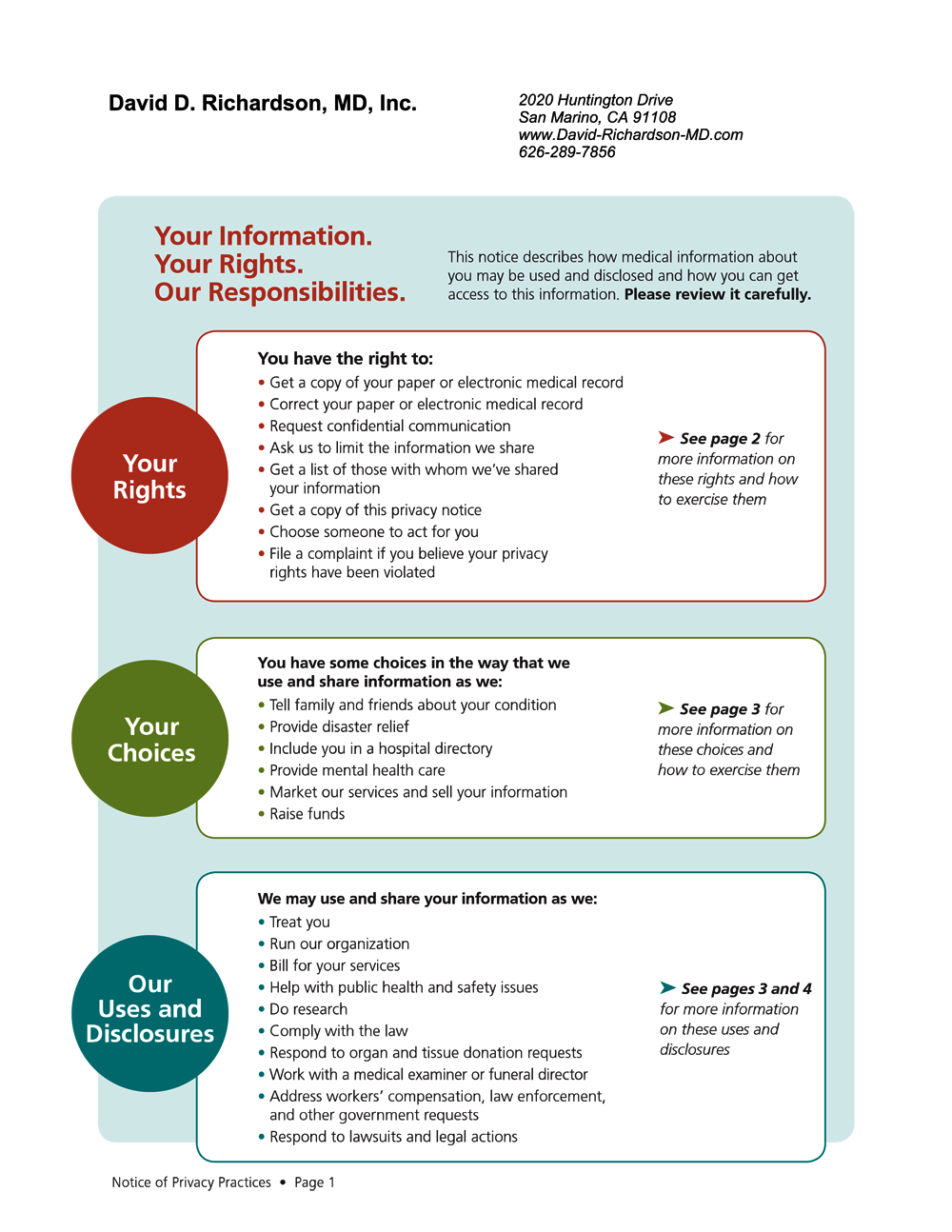
THIS NOTICE DESCRIBES HOW  MEDICAL INFORMATION ABOUT YOU MAY BE USED AND DISCLOSED BY DAVID D. RICHARSON, M.D., INC.  AND HOW YOU CAN GET ACCESS TO THIS INFORMATION IN ACCORDANCE WITH THE HEALTH  INSURANCE PORTABILITY AND ACCOUNTABILITY ACT (HIPAA) OF 1996, PUBLIC LAW  104-191. PLEASE REVIEW IT CAREFULLY.

Effective Date: April 14,  2003

1. Purpose of this Notice. We consider any  information that concerns your health, health care or payment for that care to  be confidential and protected information. This Notice describes our privacy  practices, specifically how we use and disclose your medical information and  what rights you have with respect to this information. This information includes  your name, address, and other identifying data, and information on your health  or the health services that have been or may be furnished to you. We require all  of our employees, staff, volunteers and independent contractors to comply with  these privacy practices.

We are required by federal law  to obtain an acknowledgment from you that you received this Notice. Please sign  the attached Acknowledgment Form and return it to any staff  member.

Please feel free to contact our  office manager to discuss or request any additional  information regarding any of our privacy practice or this  Notice.

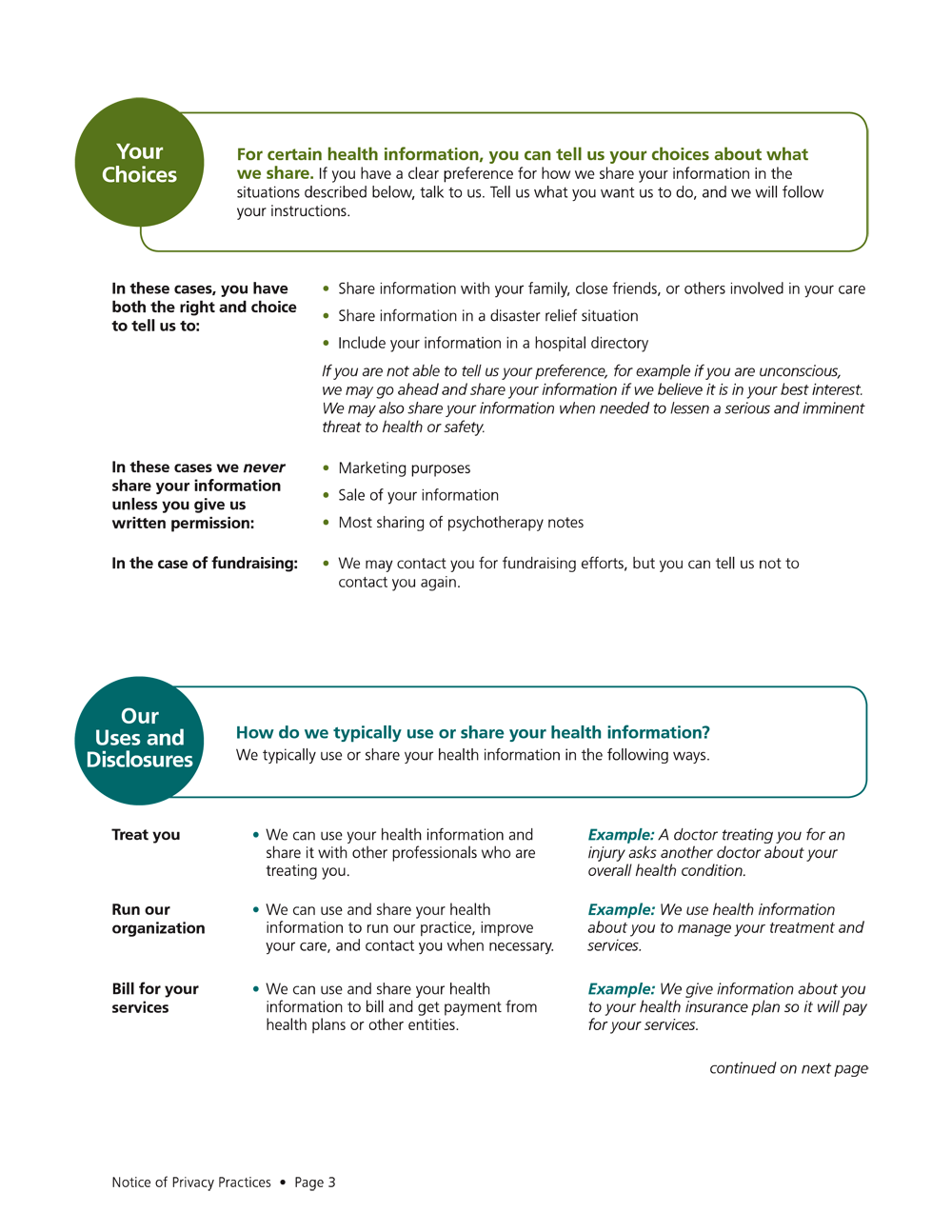
2. The Use and Disclosure of  Medical Information for Treatment, Payment and Health Care Operations. By law we  are allowed to use and disclose your medical information for most purposes  related to your medical treatment (“Treatment”), the payment for your medical  treatment (“Payment”), and our health care operations or the operations of other  covered entities to whom we disclose your medical information  (“Operations”).

Treatment means the provision,  coordination or management of health care and related services by or involving  one or more health care providers, such as the coordination of consultations and  referrals. For example, we can share most medical information regarding your  health condition with another provider as part of a consultation. We may also  contact you to remind you to make or that you already made an appointment; to  notify you regarding treatment alternatives or other health-related benefits and  services that may be of interest to you, or to raise funds for our own purposes.

Please note that by law, certain  medical information, such as psychotherapy notes, generally may not be used or  shared even when it is related to your treatment, unless we obtain an  Authorization from you to use or release that information.

Payment means activities related to  obtaining reimbursement from HMOs, insurers or other payers for services  provided to you. Payment can also cover activities to determine your eligibility  for services with your insurer, coordination of benefits with other insurers,  billing, claims management, collection, medical necessity review activities,  utilization review activities, and disclosure to consumer reporting agencies.  For example, we can disclose to your health plan medical information that is  required by the plan to determine whether the services we have provided to you  are medically necessary. We can also disclose to your health plan a list of the  services that you obtained from us so that we can be paid by the health plan for  providing the services to you.

Operations cover a range of activities that  are necessary for the business of health care providers, payors or  clearinghouses (i.e., entities performing certain billing or payment functions).  They may be performed by our employees or, in some cases, by third-party  contractors. These operations include: quality assessment and improvement  activities; peer review; credentialing and licensing; training programs; legal  and financial services; business planning and development; management activities  related to privacy practices; customer services; internal grievances; creating  de-identified information for data aggregation or other purposes; fundraising;  certain marketing activities; and due diligence activities. For example, we  evaluate practitioner performance to ensure that they meet our quality  standards. Engaging counsel to defend us in a legal action is another activity  that is considered health care operations. Another example involves fundraising  activities, in which we, a related foundation or an independent contractor may  contact you in order to raise funds for us.

3. Authorizations for Other Uses  and Disclosures of Your Medical Information. Unless a use or disclosure is  permitted for treatment, payment or operations purposes under Section 2 of this  Notice, or is permitted or required under Section 4 or 5 of this Notice, we must  obtain a signed Authorization from you to use or disclose your medical  information. We may also require an Authorization when using or disclosing  certain highly protected information, such as substance abuse information. An  Authorization is a written permission that specifically identifies the  information that we will use or disclose, and when and how we will use or  disclose it. You may revoke an Authorization at any time except to the extent  that we have already used or disclosed your information in reliance on your  Authorization.

4. Use and Disclosure of Medical  Information Without Your Consent or Authorization If You Don’t Object Verbally. Under certain  circumstances, we may use or disclose your medical information without an  Authorization or other written permission from you if we give you the  opportunity to agree or object verbally. These circumstances are as  follows:

a. For our  facility directory. After we have given you the  opportunity to refuse, or in an emergency when we believe that you would want  such information to be shared, we can include in our facility directory your  name, location in our facility, general health condition and religious  affiliation. We may also share relevant information in our directory with clergy  or members of the public who inquire about you.

b. To a  relative, friend or individual involved in your care. We may provide medical  information about you to your relative or friend, or another individual involved  in your care. We will attempt to seek, or, in some circumstances, using our  professional judgment, will infer your permission to make this disclosure. If we  are not able, for instance, because of your condition or because you are not  immediately present, we will use our best judgment to determine whether you  would want this information shared.

c. For  disaster relief. We may use or disclose your  medical information to an entity that assists in disaster relief efforts.

5. Use and  Disclosure of Medical Information Without Your Consent or Opportunity to Agree  or Object Verbally. In the following situations, we  are permitted under law to use or disclose your medical information without  obtaining your consent or authorization or allowing you to agree or object.

    • i. to report a birth, death, disease or injury, as required by law;

      ii. as part of a public health investigation;

      iii. to  report child or adult abuse or neglect, or domestic violence, as authorized by law;

      iv. to report  adverse events (such as product defects), to track products or assist in product  recalls or repairs or replacements, or to conduct post-marketing surveillance,  as required by the Food and Drug Administration;

      v. to notify  a person about exposure to a possible communicable disease, as required by law; and

      vi. to your  employer if, we are conducting an evaluation relating to the medical  surveillance of the employer’s workplace or to evaluate whether you have a work  related injury and only to the extent that the disclosure concerns such  surveillance or injury.

a. As  required by law. Numerous state, federal and  local laws permit or require certain uses and disclosures of medical  information. However, we may only use or disclose your medical information to  the extent authorized by the law.Â

b. To  business associates. We may disclose your medical  information to our business associates who perform functions on our behalf if we  first receive satisfactory assurance that the business associate will safeguard  your information.Â

c. For  public health activities. We may be asked or required by  law to divulge medical information to a public health authority under the  following circumstances:

d. For  health oversight activities. Health oversight activities  include audits, government investigations, inspections, disciplinary  proceedings, and other administrative and judicial actions undertaken by the  government (or their contractors) by law to oversee the health care system. We  may be asked or required to share medical information with a health oversight  agency for these activities.Â

e. To  report victims of abuse, neglect or domestic violence. If we believe that you are a  victim of abuse, neglect or domestic violence, it may report this information to a governmental authority, social  service or protective services agency if we believe the disclosure is necessary  to prevent serious harm to you or another individual, if you cannot agree, or if  the disclosure is required by law. If we make such a disclosure, you will be  notified promptly unless notification to you would place you at serious risk of  harm or is otherwise not in your best interest.

f. For  judicial and administrative proceedings. We may disclose medical information  as required by a court or administrative order, or in some instances pursuant to  a subpoena, discovery request or other legal process.

g. To law  enforcement. Police and other law enforcement may seek medical information  from us. We may release this information to law enforcement under limited  circumstances, for example, when the request is accompanied by a warrant,  subpoena, court order, or similar legal process, or when law enforcement needs  specific information to locate a suspect or stop a crime.

h. To  coroners, medical examiners and funeral directors. We may release  information regarding a person who has died as required by law or in order to  facilitate funereal activities.

i. For  organ, eye, and tissue donation. We may provide medical information to organ  procurement organizations and similar entities in order to facilitate organ, eye  and tissue donation and transplantation.

j. For  research purposes. We may be approached by researchers to provide medical  information for research purposes, such as tracking a particular disease. We may  provide medical information to a researcher who has obtained a special waiver  that allows the researcher to collect patient’s medical information without  first obtaining the patient’s permission. These waivers must be obtained from a  committee established under federal law to oversee medical research. The  researcher must demonstrate to the committee that the information is necessary  to the research and poses a minimal risk of an inappropriate use or  disclosure.

k. To  avert a serious threat to health and safety. We may use or disclose your  medical information to avert a serious and imminent threat to the health and  safety of an individual or the public.

l. For  military and other specialized government functions.

i. Armed  Forces. We may disclose your medical information if you are a member of the  Armed Forces, as deemed necessary by military command authorities, and if you  are foreign military personnel, to your appropriate  authority.

ii. National  Security and Intelligence. We may disclose your medical information to  authorized federal officials for lawful intelligence, counterintelligence, and  other national security activities, and for protective services to the President  and other heads of state or authorized persons.

iii.  Correctional Institutions. If you are an inmate, we may disclose your medical  information to correctional institutions or law enforcement personnel having  lawful custody of you for administration and maintenance of the safety, security  and good order of the correctional institution; of identification necessary to  provide health care to you, or to protect you, other inmates, employees and  officers of the institution, individuals participating in your transportation,  or law enforcement at the institution.

iv. Other  Government Agencies. We may disclose your medical information to other  government entities that administer public benefits to populations similar to  the population that we serve, if necessary to coordinate the functions of the  programs.

m. For  worker’s compensation. We may share information  regarding work-related illnesses and injuries in order to comply with worker’s  compensation laws.

n. Other  permitted disclosures. We may disclose your medical  information as required or permitted by the privacy regulations promulgated  pursuant to the Health Insurance Portability and Accountability Act, as amended  and interpreted from time to time.

5.  Individual Rights. You have the following rights  with respect to your medical information:

a. Restrictions. You have the right to request in writing to us to restrict  how we use and disclose your medical information. We do not have to agree to the  restrictions that you request. If we do agree to the restrictions that you  request, we must comply with the restrictions, except in emergency  circumstances. We also have the right to ask you to revoke a restriction. Please  contact office manager, Mrs. Carol Yaitanes to request a  restriction.

b. Confidential Communications. You have the right to request in writing  that we restrict the way in which we communicate information regarding your  health, health care services, or payment. For example, you may ask that we  communicate with you only at your home, not at your workplace. We will use  reasonable efforts to accommodate your request. Please contact office manager,  Mrs. Carol Yaitanes to obtain a form to use to make this  request.

c. Access. You have the right to inspect and copy most of your medical information  maintained by us. Normally, we will provide you with access within 30 days of  your request. We may charge a reasonable copying fee. In certain limited  instances, we may deny you access, for example, when the request is for  psychotherapy notes. You have the right to a review of a denial of access to  your medical information. Any request to inspect and copy medical information  should be made to office manager, Mrs. Carol Yaitanes.

d. Amendment. You have the right to request that we amend your written  medical information. For instance, you can request that we correct an incorrect  surgery date in your records. We will generally amend your information within 60  days of your request, and will notify you when we have amended your information.  We can deny your request in certain circumstances, such as when we believe that  your information is accurate and complete. You can file a statement of  disagreement to a denial of your request for amendment, to which we may file a  rebuttal. Please direct any request to amend your medical information to office  manager, Mrs. Carol Yaitanes.

e. Accounting. You have the right to request an accounting from us of  certain disclosures made by us during the 6 years prior to your request, but no  earlier than April 14, 2003. We will generally provide you with your accounting  within 60 days of your request. Your request will be filled at no cost to you  once every 12 months. For additional accountings, we will notify you in advance  of the cost and give you an opportunity to continue or withdraw your request.  These disclosures do not include those made for purposes of Treatment, Payment  or Operations, those made pursuant to a signed Authorization, or for our  facility directory or other disclosures described in Section 2 of this Notice.  Please forward any accounting request to office manager, Mrs. Carol  Yaitanes.

f. Paper  Notice. If you have obtained this Notice electronically, you may obtain a  paper copy by contacting any staff member.

g. Complaints. If you believe that any of your rights with respect to your  medical information have been violated by us, our employees or agents, you may  file a complaint with us and/or to the Secretary of the U.S. Department of  Health and Human Services. Please contact office manager for a complaint form. Under no circumstances will we take any retaliation  against you for filing a complaint.

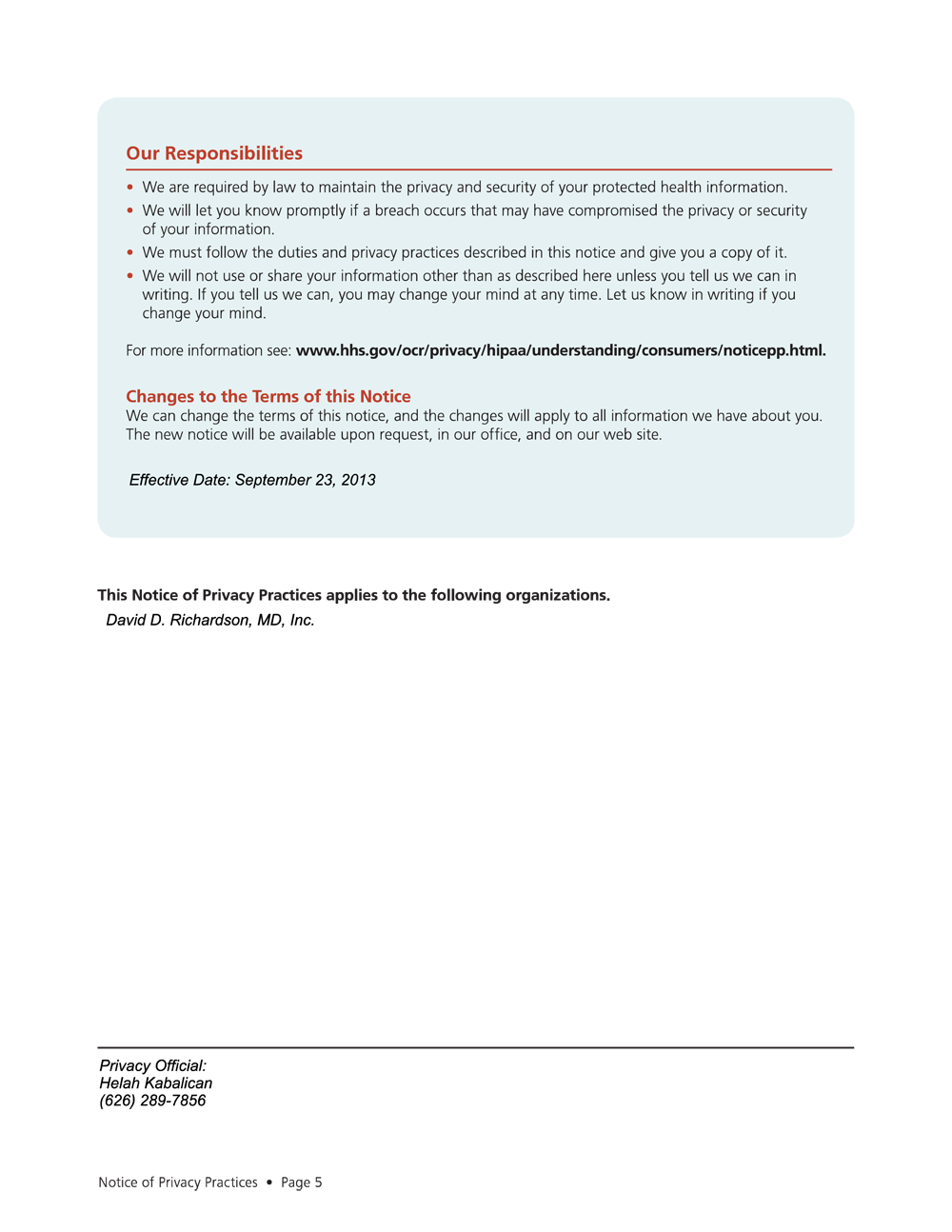
6.  Our Duties. We  are required by law to maintain the privacy of your medical information and to  provide you with this Notice of our legal duties and privacy practices with  respect to your medical information. We must comply with the Notice currently in  effect.

We reserve  the right to revise this Notice and will revise the Notice if we materially  change any use, disclosure, individual right or legal duty or other privacy  practice stated in this Notice. If we revise a Notice, copies will be available  by asking office manager, or any staff member. We reserve  the right to change our privacy practices retroactively with respect to  information that we created or received prior to issuing a revised  Notice.

IF YOU WOULD LIKE A COPY OF THIS NOTICE
PLEASE ASK ONE OF OUR STAFF MEMBERS